Stats from World Linguistics Day 2025

On November 26, 2025, linguists and linguistics enthusiasts celebrated World Linguistics Day from 70 cities, 34 countries, and 5 continents. We counted 127 greetings in total and we’re overjoyed to see the excitement for designating a day to celebrate linguistics in all its forms and we look forward to many World Linguistics Days of the future!

The Linguistic Association of Finland got in on the World Linguistics Day love:

Happy World Linguistics Day from the Linguistic Association of Finland!Today, the association's board had a meeting and discovered that NINE excellent theses had been submitted to the Master’s Thesis Award 2025!Now the jury will read all the theses and announce the winner in February 2026. 🏆

Suomen kielitieteellinen yhdistys SKY (@linguistics.fi) 2025-11-26T15:41:55.975Z

And there were two video competitions launched in the UK to explain what linguistics is and why it’s important (in English) and what sign language linguistics is and why it’s important (in British Sign Language or International Sign) co-sponsored by the Linguistics Association of Great Britain, the British Association for Applied Linguistics, the University of Birmingham, Cambridge University Press, and the European Research Council. (Note that World Linguistics Day was first celebrated in the UK as National Linguistics Day.)

HAPPY LINGUISTICS DAY!🥳🎉🗣️@lagbling.bsky.social @baal-linguistics.bsky.social @universitypress.cambridge.org and the University of Birmingham are running two competitions in linguistics for ALL UG/PGT/PGR students and ECRs to enter! find details on both competitions below 👇🏽 Good luck! 💸

LAGB Postgraduate Student Committee (@lagbpsc.bsky.social) 2025-11-26T16:34:57.817Z

World Linguistics Day greetings were shared in 6 languages: Chinese, English, German, Norwegian, Portuguese, and Spanish. (We can definitely increase this number next year, right?)

Here’s the full list of countries that we saw Happy World Linguistics Day greetings from, for people who like browsing long lists, with subregions indicated when there were 3 or more:

  1. Aotearoa / New Zealand
  2. Argentina
  3. Australia
  4. Austria
  5. Brazil
  6. Canada (6 provinces)
  7. Chile
  8. Colombia
  9. Costa Rica
  10. Croatia
  11. Czechia
  12. El Salvador
  13. Finland
  14. France
  15. Germany (4 states)
  16. Greece
  17. Hungary
  18. India
  19. Ireland
  20. Japan
  21. Mexico
  22. Netherlands
  23. Norway
  24. Philippines
  25. Poland
  26. Portugal
  27. Spain
  28. Sweden
  29. Switzerland
  30. Taiwan
  31. Turkiye
  32. United Kingdom (England, Scotland, and Wales)
  33. United Arab Emirates
  34. United States (17 states)

We’ve tried to compile all the World Linguistics Day greetings we saw across various social media sites, but there were way more than we were expecting so if we’ve accidentally missed you please let us know!

World Linguistics Day
November 26, 2025
stats! 
127 greetings
34 countries
70 cities

LingComm IRL at a Summer STE(A)M Program — Interview with Marisa Brook and Daniel Currie Hall

Marisa Brook and Daniel Currie Hall are both professors of English and Linguistics at Saint Mary’s University in Halifax, Nova Scotia. They kindly answered our questions for this LingComm IRL interview, a series edited by Gretchen McCulloch and Leah Velleman highlighting face-to-face, community-driven linguistics communication activities without much of a web presence to help lingcommers learn from each others’ experiences in doing local activities.

What community group(s) or organization(s) did you work with?

Shad Canada, which has run a month-long summer STE(A)M program for high-school students since the early 1980s. Participants are typically 16–17 years old. Each of them spends a month living in residence at one of the host universities, with an intense and eclectic schedule of lectures, workshops, field trips, and recreation.

The Shad program runs in parallel at 25 host campuses (plus an online distance-learning option) for one month every summer. The program is structured in similar ways across universities, but each campus has a local flavour shaped by its people and research specialties.

How did you get started working with Shad? 

Marisa: I attended Shad myself when I was 16, at the University of Waterloo. A cousin of mine had attended the year before and reported having had a wonderful time. Because of that, and because I was toying with the idea of going into engineering, I thought I might as well apply. The program was a huge boost to me both intellectually and socially, and meant I was no longer intimidated by the idea of going away to attend university. I spent about twenty years hoping I’d have a good chance to give back by working for Shad someday. My chance arose in 2024, when two things happened at the same time: I took up a faculty position at Saint Mary’s University and Saint Mary’s signed on as a new Shad host campus to begin in June–July 2025. I happily agreed to serve as a Faculty Fellow (a general mentor figure representing the host campus, and a flexible extra staff member). In the meantime, I ran around campus excitedly telling other faculty members that they should come give talks/workshops for Shad about their research areas and/or creative work.

Daniel: Marisa told me about it! (I’d like to think I would have recognized Shad as an excellent opportunity to spread awareness of linguistics in any case, but Marisa’s enthusiasm really drove the point home.)

What sort of lingcomm project did you do with them?

Daniel: I started with an exercise from Maya Honda and Wayne O’Neil’s textbook Thinking Linguistically about how to apply the scientific method to the study of language: see a set of data, identify a pattern, make predictions, test them, and revise your hypothesis as needed. After that, I did some phonetics demonstrations involving aspiration in English: using tissue paper to see that the [p] in spy looks more like the [b] in buy than the [pʰ] in pie, then using Praat to edit recordings we made on the spot (e.g., turning “buy the spread” into “spy the bread”). The handout included instructions for getting started using Praat on one’s own and some suggestions for other things to try doing with it. At the end of the session, I took questions from the students, which were impressively insightful and wide-ranging; they asked all kinds of things about language and linguistics, not just about what we had done in the session itself.

Daniel’s handout

Marisa: I gave a talk on long-term language change: etymology, the comparative method, and how on earth we can know anything about an ancestral language such as Proto-Indo-European when it was never written down. The follow-up handout guided students through exploring PIE etymology with the digital version of the American Heritage Dictionary of Proto-Indo-European Roots, and prompted students to look for cognates and uncover a recurring correspondence between Latin /s/ (preserved from PIE) and Greek /h/ (an innovation).

Marisa’s handout

What are a few specific things you did that the students resonated with?

In the lectures, asking for a volunteer from the group caught the students’ attention quickly. Making time for the students to ask open-ended questions of their own about language was crucial, as the Shad participants were all very intellectually curious and might never have had an earlier opportunity to get direct answers from experts about how languages work. There was enough interest that the questions after each lecture could have gone on for an hour or more. At the end of the program, several students mentioned linguistics as a highlight. A few approached one or both of us to ask excellent additional questions or make requests for further reading, and more than one even asked where they could hypothetically go to study linguistics at the undergraduate level.

Linguistics is a natural addition to STEM-based summer enrichment programs for young people. We encourage everyone based in Canada who has linguistics training to look up where your nearest Shad host campus is for 2026 and consider offering to give a talk or workshop.

What’s something you’d do differently next time?

Double-check that the audiovisual systems in classrooms inside the newest building on campus can play audio through externally-connected laptops. Contrary to expectation, ours could not.

Where can people find more about you or get in touch if they’re working on a similar project? 

Daniel: https://incl.pl/dch/
Marisa: https://marisabrook.com/

LingComm IRL is a series bringing attention to under-documented face-to-face lingcomm projects. Do you know of a great IRL lingcomm project that doesn’t have much if any information about it online yet? Let us know! Does your lingcomm project have a website with information about its structure so other people can use it as a model? Let us know so we can link to it from the LingComm Resources page.

Other recent posts:

World Linguistics Day

In April, at the LingComm25 conference, we found out that the UK has been celebrating National Linguistics Day on November 26, and many lingcommers got excited at the idea of taking these celebrations international.

Apparently November 26th is National Linguistics Day in the UK because it's de Saussure's birthday??Just found this out from @adamcschembri.bsky.social at #LingComm25 and the chat immediately goes wildWorld Linguistics Day, anyone???#linguistics

Gretchen McCulloch (@gretchenmcc.bsky.social) 2025-04-09T15:35:41.981Z

We’re now exactly a month until World Linguistics Day! Looking forward to seeing what people do in celebration. It’s always great to have an excuse to share something (serious or silly) about linguistics.

Make sure to use the hashtag #WorldLinguisticsDay on whatever platform you’re sharing on so we can all find each other!

Other national and international language-related days: International Mother Language Day (Unesco), Sign Languages Day (UN), Official Languages Day (Canada), saints days for Hildegard of Bingen (one of the first conlangers) and Gottschalk (patron of languages, linguists, princes, translators, lost vocations), World Emoji Day.

LingComm IRL with Skeptics — Interview with Lee Murray

Lee Murray is a doctoral candidate in linguistics at Monash University in Melbourne, Australia. They present on linguistics to skeptic groups — who they describe as “evidence-based-reasoning enthusiasts” — and also write a linguistics column called “By Lingo!” for The Big Issue magazine. Lee kindly answered our questions for this LingComm IRL interview, a series edited by Gretchen McCulloch and Leah Velleman highlighting face-to-face, community-driven linguistics communication activities without much of a web presence to help lingcommers learn from each others’ experiences in doing local activities.

How did you get involved in presenting IRL about linguistics?

A friend of a friend asked if I’d give a sociolinguistics talk to a regional skeptic group, and from there I was invited to speak at their national convention, Skepticon. I was an invited speaker at two Australian Skepticon conventions. 

What sort of presentation did you give?

My research focuses on the kinds of social decisions we make about each other based on how we talk, which meant I could speak to a skeptic audience about unconscious social biases and how we attach them to ways of speaking.

What are a few specific things you did that really resonated with that audience?

Definitely my Skepticon talk titled “So you’ve corrected someone’s grammar on the internet…”. It was heaps of fun to both write and present, and delegates even told me that I’d changed their minds on the topic and they’d be changing their online behaviour accordingly. (I love it when I get to use my powers for good!)

What’s something you’d do differently next time?

I’d make sure the signal of my slide clicker was strong enough to get through the closed stage door… 

(Ask me how I know.)

Where can people find more about you or get in touch if they’re working on a similar project? 

You can find me (and contact me) at leemurray.com.au.

LingComm IRL is a series bringing attention to under-documented face-to-face lingcomm projects. Do you know of a great IRL lingcomm project that doesn’t have much if any information about it online yet? Let us know! Does your lingcomm project have a website with information about its structure so other people can use it as a model? Let us know so we can link to it from the LingComm Resources page.

Other recent posts:

LingComm IRL with Young Linguists Language Club in Estonia – Interview with Mari-Liis Korkus

Mari-Liis Korkus is a PhD student in Estonian and Finno-Ugric Linguistics at the University of Tartu, who’s been organizing a linguistics club with high school students in Tartu, Estonia since 2023. Mari-Liis kindly answered our questions for this LingComm IRL interview, a series edited by Gretchen McCulloch and Leah Velleman highlighting face-to-face, community-driven linguistics communication activities without much of a web presence to help lingcommers learn from each others’ experiences in doing local activities.

What community group(s) or organization(s) did you work with?

I’ve been interested in linguistics – and languages more broadly – since I was a teenager, partly because I grew up in a bilingual family. During the first year of my PhD studies, I became increasingly interested in communicating linguistics to teenagers. At first, I gave occasional workshops as part of the Teen Speak in Estonia research project. Eventually, I initiated Noorlingvistide keeleklubi (in English: Young Linguists Language Club) to engage with them more regularly.

How did you get started making a linguistics club for teens?

The idea came to me during a conference in 2022, when I was discussing with the head of our institute, Professor Liina Lindström, the various ways of engaging more Estonian youth in linguistics and broadening their general knowledge of Estonian and other languages. Having experience presenting to younger audiences and drawing inspiration from the initiatives introduced at the #LingComm21 conference, I expressed interest in helping launch a project that would serve this purpose. Professor Lindström greenlit the idea, and just a few months later, in March 2023, I was standing in a small classroom, hosting the very first meeting of Noorlingvistide keeleklubi.

What does your linguistics club look like now?

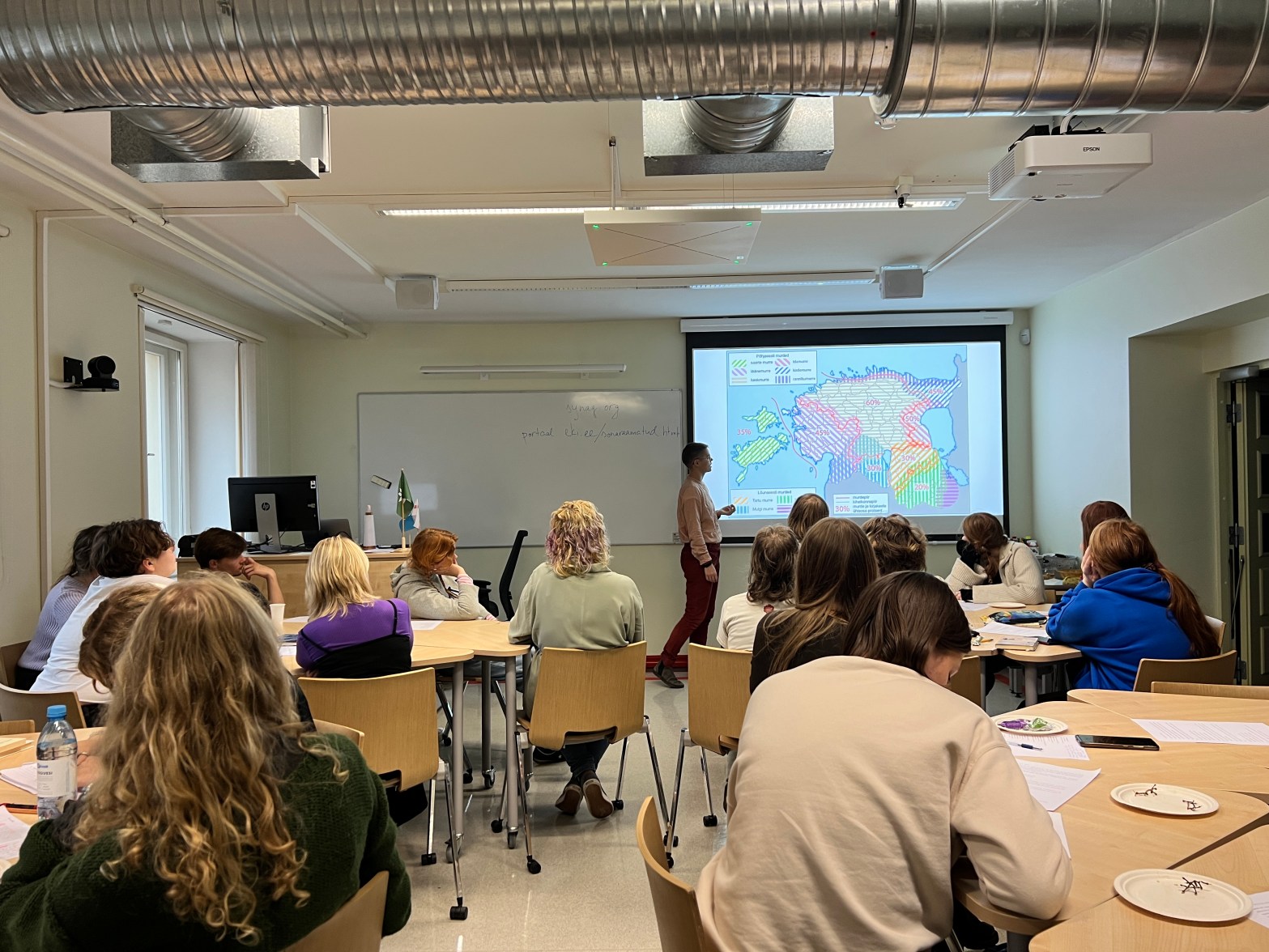
Noorlingvistide keeleklubi is a monthly linguistics club at the Institute of Estonian and General Linguistics of the University of Tartu. It’s a kind of meeting spot for lingthusiastic high school students [grades 9-12, age 15-18] who want to learn more about how languages work – especially those spoken in Estonia. The meetings are held once a month on Saturdays, lasting for about three hours. Each meeting features one or more linguists who give a talk and host a workshop on a specific topic. So far, topics have ranged from Estonian dialects to conlangs, from feminist linguistics to onomastics. Although I’m primarily involved in the organizational side of the club, I’ve also given a talk on two occasions. This year, the club also hosted its first-ever two-day camp, where students got an introduction to psycholinguistics. At various times, the Estonian Ministry of Education and Research and the Estonian Research Council have supported the club’s activities. Thanks to this support, students can attend all club events for free. If you’re interested in learning more, I’ve written an overview of the club for Linguistics Vanguard.

What are a few specific things you did that the club members resonated with?

A few examples come to mind from the past year. To engage a younger audience, it’s important to see things from their point of view and find ways to connect the topic to their experiences. Adding a personal touch can make them genuinely want to listen. For instance, we had a session on multilingualism where students created their language portraits. Many realized they’re much more multilingual than they thought and that multilingualism comes in many forms. Interactive activities can make a big difference too. In our meeting on Finno-Ugric languages, students played games (like Bingo and Memory) based on the lecture. It kept them focused and engaged even the shyest students. But probably the biggest thing I’ve learned through the club is how important it is to show passion. When the speaker is a little nerdy and excited about the topic – like it’s the most interesting thing in the world – that energy can become contagious. You might see how it lights up a spark in a student’s eyes!

What’s something you’d do differently next time?

I wouldn’t say I want to change anything, but rather, I’m looking for ways to expand the project. For example, when it comes to the monthly meetings, I think it would be interesting to occasionally hold them in different locations by collaborating with local museums or language centers. This year’s camp was a big success, since we filled all the spots in less than a week. So in the future, it would be great to organize a longer camp, which would last maybe four or five days instead of just two. I’ve also been thinking about how to build more of a sense of community among participants, so they’d interact more during breaks and also outside of the club. One idea I’ve considered is creating a social media account or a newsletter that the students could help run together.

Where can people find more about you or get in touch if they’re working on a similar project? 

I would love to connect with anyone doing LingComm IRL or online, especially with a focus on youth. Feel free to reach out to me via my e-mail: mariliis.korkus@gmail.com!

LingComm IRL is a series bringing attention to under-documented face-to-face lingcomm projects. Do you know of a great IRL lingcomm project that doesn’t have much if any information about it online yet? Let us know! Does your lingcomm project have a website with information about its structure so other people can use it as a model? Let us know so we can link to it from the LingComm Resources page.

LingComm mailing list

To help you stay connected to other people doing lingcomm, we’ve started a new mailing list especially for lingcomm. LingComm social media continues to exist, but the social landscape is increasingly fragmented so this is a way to have a semi-public professional contact point for everyone doing lingcomm.

This group is a space to share information about lingcomm practice. This includes, but is not limited to, conferences, events, journal special issues and other information of interest to lingcomm practitioners.

This mailing list has been set up as a Google Group. Conversations in this group are publically available on the internet, but only group members can post. If you sign up as a group member you will get email updates directly to your inbox, and you can reply to those updates in your email (the replies are then posted in the public group). This mailing list is a place to connect with colleagues, not audiences.

You can see the list and sign up here

LingComm IRL with Girl Scouts – Interview with Nikole Patson

Nikole Patson is a psycholinguistics professor at the Ohio State University, who’s been doing lingcomm with Girl Scouts in Columbus, Ohio, USA. Dr Patson kindly answered our questions for this inaugeral LingComm IRL interview, a series edited by Gretchen McCulloch and Leah Velleman highlighting face-to-face, community-driven linguistics communication activities without much of a web presence to help lingcommers learn from each others’ experiences in doing local activities.

How did you get started working with Girl Scouts in your area?

I am one of the directors of the Language Pod, a language science lab at the Center for Science and Industry (COSI) in Columbus, OH. I was put in contact with a program manager at the Girl Scouts who is in charge of coordinating partners for programming. They were very excited to work with us and flexible with content. The Girl Scouts did all of the advertising, we just did the program.

What sort of lingcomm project did you do with the your local Girl Scout troop? 

We developed a program based on the Cadette’s [age 11-14] public speaking badge. The girls did not earn the full badge with us, but the activities were fun and allowed us to get in some language science content. We are making this an annual event.

What are a few specific things you did that the Girl Scouts resonated with?

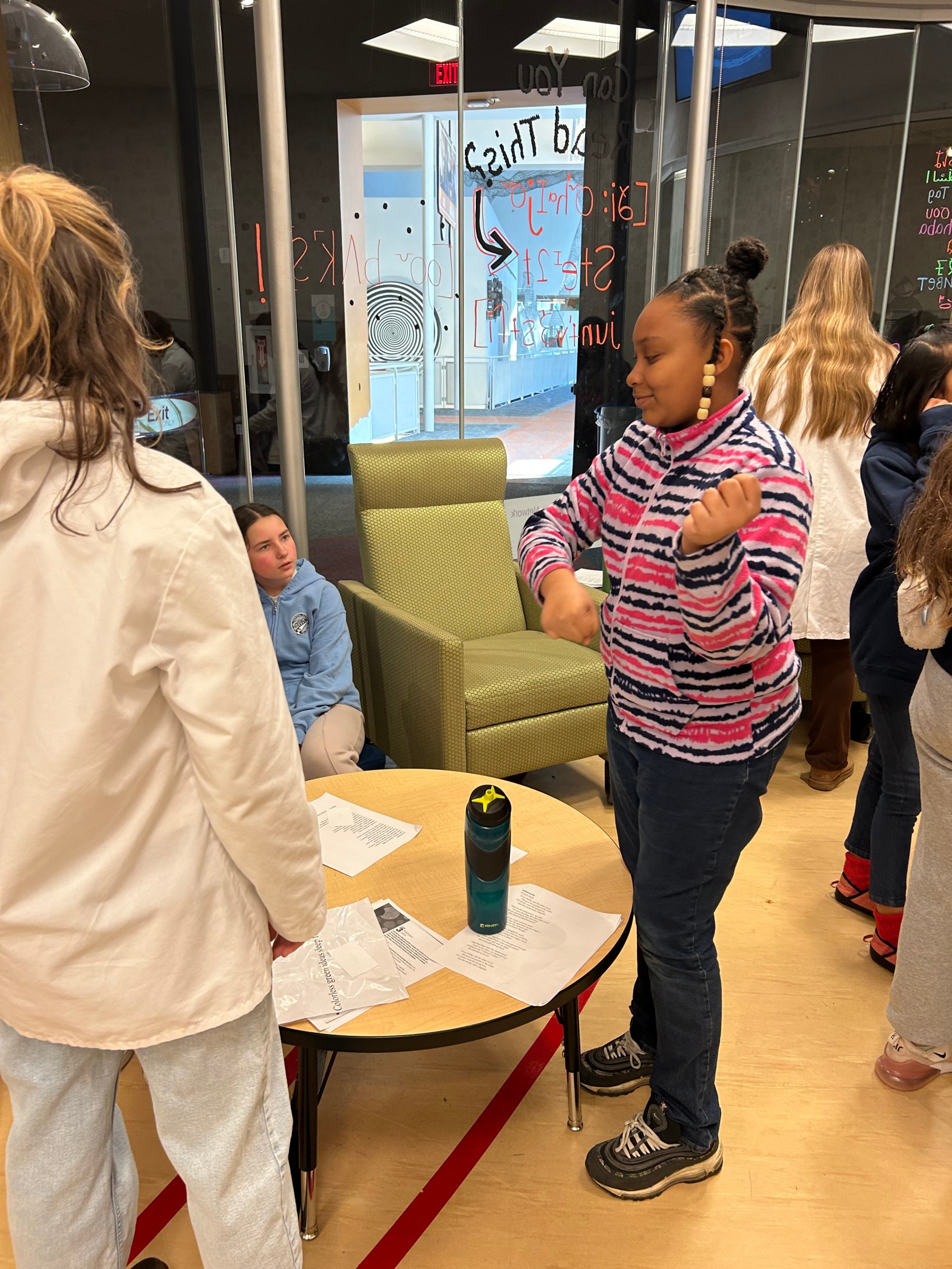
We had the Girls play charades, read poems out loud, and read words and sentences with different emotions. These were the requirements for the Public Speaking Badge. We infused a bit of linguistics/language science into each of the activities. For example, we discussed prosody when talking about emotions and used Jabberwocky as one of the poems.

What’s something you’d do differently next time? 

We would love to see more language science in the Girl Scout curriculum. The public speaking badge was not ideal, but was the best fit for doing this work. We’re going to continue the program to keep the relationship, but we are interested in exploring new possibilities, including creating a language science badge. We’re open to collaborators if you are already working with the Girl Scouts in your region!

Where can people find more about you or get in touch if they’re working on a similar project? 

Send me an email: patson.3@osu.edu

LingComm IRL is a series bringing attention to under-documented face-to-face lingcomm projects. Do you know of a great IRL lingcomm project that doesn’t have much if any information about it online yet? Let us know! Does your lingcomm project have a website with information about its structure so other people can use it as a model? Let us know so we can link to it from the LingComm Resources page.

Poster Sessions @ LingComm25

Poster sessions at LingComm25 are not your typical academic-style poster presentations—rather, these posters are conversation starters, meant to spark discussions between conference attendees and poster presenters. Posters cover a range of lingcomm topics, from lingcomm on Instragram across languages, to lingcomm in museums, at science festivals, and in the classroom.

You can read all poster abstracts below.

(Odd-numbered posters are presented in Session 1. Even-numbered posters are presented in Session 2. View the conference programme here.)

  1. Portia Washington & Hannah Mechtenberg, An Adaptable Model for Science Communication and Lab Outreach: The Lab Digest
    The Spoken Word, produced by Portia Washington and Hannah Mechtenberg, is a research magazine written by undergraduate researchers. We publish annually, and are currently preparing our tenth issue. Our primary audience are patients with language disorders and their caregivers. Patients are an inherently diverse group, spanning all demographic dimensions. They are also largely excluded from engaging with language research, which we’ve sought to correct. We aspire to include everyone in language science, regardless of their background. Our articles feature themes of patient advocacy, cutting-edge clinical interventions, and inclusion and representation in the language sciences.
  2. Luciana Sanchez Mendes & Vitor Hochsprung, Why (not) Indigenous Languages on Instagram?
    The main goal of this poster is to discuss how the scientific dissemination of grammatical studies of indigenous languages spoken in Brazil can contribute to the development of metalinguistic awareness of Brazilian Portuguese speakers in their native language. We base our idea on two theoretical backgrounds: indigenous languages Linguistics and the scientific dissemination of Linguistics in the Brazilian context. By combining these two areas of knowledge, we propose that we, as linguists, should include the goal of developing metalinguistic awareness in the scientific dissemination strategies of our field. Our strategy for this is to adopt indigenous languages as tools for popularizing our studies.
  3. Charlie Farrington & Tyler Kendall, Creating and Maintaining the Online Resources for African American Language
    The Online Resources for African American Language (ORAAL) was created as a host for the Corpus of Regional African American Language (CORAAL; Kendall & Farrington 2023) as well as a clearinghouse for information about AAL. Originally housed at the University of Oregon, ORAAL is now available at oraal.github.io. In this poster, we discuss the information available on ORAAL, as well as creating and maintaining new content for different audiences (e.g. researchers, educators, and the public). We also hope to hear from the LingComm audience about the kinds of information they would like to see on such a website.
  4. Leslie C. Moore, Laura Wagner, Anna Babel, & Kathryn Campbell-Kibler, ¡Aquí se habla español! Public Outreach at COSI in Spanish
    The goal of this project was to develop a set of language science activities that featured the Spanish language as their subject matter and could be conducted in Spanish. These activities were integrated into existing public outreach efforts of the Language Sciences Research Lab embedded within a science center. In our lightening talk, we will provide a brief overview of this pandemic-era project and discuss 3 key lessons learned: (1) how and why to follow the lead of our community partners when developing language science outreach, how to make a video pivot when f2f outreach is not possible, and (3) navigating and negotiating outreach language choices in ways that respect diverse preferences among museum visitors.
  5. Malwina Gudowska, Mother Tongue Tied & Motherlingual
    A book and newsletter exploring the intersections of multilingualism, language, motherhood, memory and more:
    MOTHER TONGUE TIED: On Language, Motherhood & Multilingualism – Disrupting Myths & Finding Meaning (Footnote Press, 2024) explores the emotional weight of raising multilingual children while grappling with one’s own linguistic and cultural identity and notions of home. The book sheds light on the ways in which we navigate language, its power to shape and reshape lives, and the ripple effects felt far beyond one home or one language. It is an examination of everything from love in multiple languages, language and food, the care work of raising multilingual children, to accentism, linguicide and language revitalisation.
    MOTHERLINGUAL, a “Top Parenting Substack” (Motherly, 2024) continues the conversation with weekly newsletters on linguistic inequality, raising multilingual and multicultural children, ideas of heritage, home, identity, and much more.
  6. Claudia Borghetti, Caterina Mauri, Ludovica Pannitto, Eleonora Zucchini, & Gianluca Iacovantuono, Exploring and experiencing spoken Italian through the KIParla corpus
    The poster will illustrate a dissemination activity designed for the European Researchers’ Night 2024, based on the KIParla corpus, a collection of more than 200 hours of conversation in Italian recorded all over the country. The activity consists of two board games, targeted at the general public, that aim to deconstruct the idea of a unitary linguistic identity.
    By listening to audio tracks and answering to quizzes, players explore and discover a series of lexical and grammatical properties that characterize regional and social Italian varieties, and that can influence how language is spoken in conversation. The activity then wraps up with a final set of questions aimed at eliciting thoughts and considerations about linguistic diversity.
  7. Suzanne Evans Wagner, Betsy Sneller, & Jack Rechsteiner, Branding your research
    The science communication literature is often oriented to conveying research results and/or established knowledge to various publics. Yet researchers, including linguists, also communicate with publics in order to recruit them as participants. Recruitment communication must economically convey that the researcher is both trustworthy and approachable. We’ll share our experiences of ‘branding’ our longitudinal sociolinguistic project, MI Diaries, include examples from other projects (Manchester Voices, Our Dialects, Accent Bias in Britain) and give some tips on how to apply brand thinking.
  8. Charlotte Vaughn, Sarah Nam, Ashley Chau, Lyosha Genzel, Tzipi Harker, Isabel Harris, & Stacey Torbeso, The Language Science Station at Planet Word
    The Language Science Station at Planet Word is a pop-up laboratory for research and engagement about linguistics. We invite visitors to Planet Word, a museum about words and language in Washington DC, to participate in real research studies, and we talk with them about studying language scientifically. This poster will be presented by several student RAs at the LSS, sharing their experiences doing one-on-one lingcomm at the museum.
  9. Ana Beatriz Arêas da Luz Fontes, Bárbara Cardoso de Souza, & Lívia Leote Leite, How we have tried to make research findings on Psycholinguistics of Bilingualism more accessible: a report from @prolingue_gp
    Though scientific communication is an important topic on its own, creating avenues to have research findings reach readers from non-academic environments could prove a real challenge. In our research group, ProLinGue (Processamento de Linguagem Bilíngue), such a challenge has been one of our main concerns. We have thus created an Instagram account (@prolinguegp), in which we share findings and concepts from Psycholinguistics in simplified, more accessible language. At LingComm25, we would like to share our work and show the strategies and challenges we have found in the process of sharing academic knowledge in an approachable way, engaging followers, and interacting with other research groups through our Instagram account.
  10. Mary Kohn, Multilingual Midwest: Decolonial and Antiracist Pedagogies at Science Festivals
    Science festivals provide opportunities to incorporate decolonial and anti-racist pedagogies into science tabling events. This poster provides one model where volunteers offer participants a chance to print a spectrogram of their voice. While waiting, participants learn how place names reflect the languages and immigration patterns of the peoples in the region, destabilizing discourses of the monolingual English-speaking Midwest. Special emphasis is placed on Native American place names from languages still spoken in the region, emphasizing Indigenous survivance. Participants learn how their voices reflect their culture to build deeper connections to the material and are directed to documentaries on www.KansasTreaties.com.
  11. Misa Suzuki, Bonnie Barrett, & Deanna Gagne (Faculty Sponsor), In Your Hands: Empowering the Next Generation of Deaf Scientists with Cognitive Science and Linguistics Communication Outreach
    Signing Scientists’ recent project, “In Your Hands: Promoting Early Diverse Deaf Engagement in the Cognitive Sciences,” uses principles of linguistics communication (Gawne & McCulloch, 2023) to foster early interest and participation of deaf and hard of hearing K-12 students in the cognitive sciences. Since 2023, our multidisciplinary team of graduate students has created accessible linguistics and cognitive science-related educational materials in American Sign Language, connected with local educators, and visited schools to teach students about bilingualism and the brain. In this presentation, we will share our methodologies and insights gained from our experiences in science-communication, linguistics-communication, and accessible content creation.
  12. @sl2ngistik, Decoding teen lingo: experiences of running Slängistik
    Have you ever felt old while listening to how younger people speak? Or perhaps your own vocabulary has left someone with gray hairs? With these thoughts in mind, in 2023, I created ‘Slängstik’ (aka @sl2ngistik on TikTok and Instagram) – an (anonymous) account where I decode words, phrases, and emojis that are popular with Estonia’s younger generation. This account has not only given me an insider’s view of what it’s like to be a (linguistic) content creator, but also revealed how different age groups engage with and react to teen lingo in a non-English-speaking setting.
  13. Montreal Benesch, Pablo Cazares, Max Ongbongan, & Ray Perry, The trans*languaging Art Show
    trans*languaging was an art show based in Portland, OR that centered on fourteen multilingual trans artists and how our relationships with our languages are shaped by our identities. Representing our stories in audio, visual, and physical formats engaged the senses and highlighted the intersection of language and aesthetics, while the format of an art show allowed these stories to reach new audiences. Visitors expressed strong emotional responses to the exhibit, and it can be experienced in online form at https://transxlanguaging.wordpress.com/, with great thanks to LingComm for the support of the Kirby Conrod LGBTQ+ LingComm grant.
  14. Marisa Brook, Proposing an online curated Q&A blog/repository for public questions
    Since 2004, the Stanford Department of Genetics and a STEM museum called The Tech have run an online column, ‘Ask a Geneticist’. Questions submitted by curious members of the public are answered in a lively and accessible way, with text and illustrations, by genetics faculty members or Ph.D. students. I say we do the same for linguistics! A blog, but also a repository of earlier Q&As, managed by a team of experts, with particular attention paid to social-justice issues. Meant to complement and draw upon existing #lingcomm efforts rather than supplant any of these. Hoping to find colleagues interested in taking part as contributing editors/writers, illustrators or web designers, social media managers, fundraising finders, etc.
  15. Kyler Laycock and Nikole D. Patson, Sparking early interest in language science with the Girl Scouts
    Our lab’s previous research has shown that science museum visitors find language science demonstrations not only engaging but also transformative in shifting their attitudes towards the belief that language can be studied scientifically (Kaiser et al., 2024; Patson et al., 2024; Wagner et al., 2024). These demonstrations have the potential to broaden participation in science, thanks to the universal appeal of language. This presentation will unveil an exciting new program developed in collaboration with the Girl Scouts, aimed at sparking an early interest in language science among girls.
  16. – Withdrawn –
  17. Emmanuel Oladipupo Adegbuyi, Cultivating the Next Generation of Scholars: The Talklin NG Model
    TalkLin NG was founded as a platform to bridge the gap between academia and society. In Nigeria, the understanding of linguistics and its practical applications remains limited to a select few in the academia. To address this, TalkLin NG promotes language awareness, advocates for indigenous languages, and empowers young linguists. Through various initiatives, we aim to make linguistics accessible to the public and demonstrate its relevance to everyday life. This poster showcases some of our efforts in achieving these goals.
  18. Naomi Peck, Filipe Figueiredo Cruz, Myriam Michalopoulou, Pramodya Sewwandi Perera, & Albert Tallai, Zur Sprache kommen: Making research on endangered languages visible
    In this poster, we talk about our experiences in putting together the museum exhibition “Zur Sprache kommen: Visualising research on endangered languages” at the Uniseum Freiburg in Summer 2024. This exhibition represents the end product of a collaboration with active researchers and community members within a #LingComm class. The aim of the exhibition was to introduce concepts around language endangerment in a de-exoticising manner and make these concepts relevant to visitors’ daily lives. We share our experiences around the logistics of putting together an exhibition, working with both physical and digital media, embedding interactive elements into the space, and designing the accompanying outreach programme.
  19. Edissa Dorita Queiroz Boechat, Stella Maria Palitot Dias, Márcio Martins Leitão, Carolina Gomes da Silva, & Juliana Novo Gomes, Linguisticamente Falando: Active Methodologies in the Teaching of Linguistics and Science Communication to Connect Science and Education
    Associated with the Federal University of Paraíba, Linguisticamente Falando is an extension project that promotes the dialogue between linguistics education and scientific communication – mainly using active methodologies. Its platforms, including a website and Instagram, showcase authorial and other contents featuring quizzes and interviews developed by students in regular subjects under teacher guidance. In line with Pacheco (2019), this project has an ethical commitment with education, impacting directly on student autonomy, through project based learning, students lead knowledge construction, enhancing effectiveness by the variation in learning modes among students, which showed effectively disseminated academic productions.
  20. Romi Román & Emily Herman, Linguistic Diversity Across the Lifespan (LinDiv): Outreach and Science Communication
    Language Diversity Across the Lifespan (LinDiv) is a traineeship program that aims to bridge that gap between human technology and language science by applying the principles of integrated learning and transdisciplinary team science. Communication science and outreach are key components of this program. The following poster summarizes our work with different communities, features sample activities and shows how we have achieved successful outreach by following the strands for science communication (Wagner & MacKee, 2023).
  21. Sol Tovar, Class Zines as a SciComm tool in the Linguistics Classroom
    This poster explores the application of zine methodologies as a tool of feminist and critical pedagogy in the linguistics classroom. This project was carried out within the seminar ‘A Linguistics of the Oppressed’, a course destined to bachelor, master and teacher training students and designed to investigate how language shapes relationships of power and oppression. On their class feedback, students have reported feeling more empowered to express their personal experiences and insights on complex issues. The creative and less formal nature of zines encourages a break from traditional academic outputs, allowing students to experiment with storytelling, visual design, and collective knowledge-sharing.
  22. Colette Feehan, Articulatory and Acoustic Phonetics of Voice Acting
    Have you ever wondered how voice actors do THAT? Many folks do not realize that a lot of the child-like voices you hear in animated media are actually adults doing some very sneaky and complex articulatory linguistics–and most of the actors don’t even really know how they do it! This poster will summarize several of the articulatory strategies that adult voice actors can use in order to sound like a child.
  23. Jill Hallett, Date my course: Constructing dating profiles to pique undergrad interest in Linguistics
    Dream Date #5 has a favorite notebook. Their perfect date includes gazing into each other’s eyes and asking if this sentence makes sense. Dream Date #8 is turned on by someone highly contrastive and is not looking for anyone overly aspirational. Dream Date #6’s favorite color is qīng, (it means blue, green, or black). They like solving puzzles and are turned off by orientalism.
    While the Dream Dates above might be swiped left on a dating site, they are far more appealing to an overwhelmed undergrad than the official course description. This lightning talk offers a unique way to get students hyped up about Linguistics courses prior to registration.
  24. Sharon Unsworth, Pim Franssen, Imme Lammertink, & Fleur Vissers, The Language Stone: Escape game for kids
    The Language Stone is an escape-room-type interactive game centered on a large ‘stone’. Children (often together with adults) have to solve linguistically-informed puzzles to uncover what’s inside. They helped along by linguist Dr. Rosetta Steen, who appears on a screen in the stone, providing brief explanations of what they’ve learned. We co-created the stone together with a professional escape room company and have tested it out on various locations. It’s a bit hit with young and old!
  25. Cooper Bedin & Montreal Benesch, “Representing everyone else outside these two boring genders”: The role of popular media in trans language activism
    This poster uses the TV show “And Just Like That…” to frame a discussion of trans language activism and the problems with pronouns seemingly always being the beginning and end of trans-inclusive language practices. How can we use LingComm to take insights from trans linguistics (Zimman, 2020) and extend them beyond the academy? “Linguists have a unique opportunity—and, as a result, a responsibility to use our [training] to support trans advocacy,” (Zimman & Brown, 2024). It is more important than ever to positively impact popular discourses—for example, those on TV shows like AJLT—about trans people and trans language.
  26. Logan Kearsley, The Linguistically Interesting Media Index
    The Linguistically Interesting Media Index reviews media—books, TV shows, movies, etc.—of all genres, with an aim to providing case studies for how other creators can improve the representation of language and linguistics in their works. This is lingcomm targeted at a very specific audience: authors and screenwriters, mainly of science fiction and fantasy. Across several years of reviews, I have developed a typology of techniques which authors can use to effectively present multilingual content to monolingual audiences, and recommendations for how linguistics can be employed as the science in “science fiction” beyond common rehashings of the Sapir-Whorf hypothesis.

Lightning Talks @ LingComm25

Lightning Talks is a new type of session making its LingComm debut at LingComm25! In these sessions, a lineup of lingcommers share the highlights and hard lessons from their various lingcomm projects. Through five-minute talks, they offer a glimpse into their work and pass on key insights—what to embrace and what to steer clear of. Sessions 1 and 2 feature experiences with lingcomm in popular media, the use of “new tools” like ChatGPT, creative approaches in education contexts, and more!

Read on and get excited for the pearls or pitfalls you’ll be hearing about at LingComm25’s Lightning Talks sessions! 🌟


Lightning Talks, Session 1
(LingComm25 Day 1, Hour 1)

Eatymology: Viral Storytelling with Linguistics and Food
Sophia Smith Galer
“Over the last year, my series on “Eatymology”- sharing etymologies of food words via historic recipes – has had more than 10 million views on TikTok and Instagram, with one video winning me more than 140,000 followers in the space of one month. I’d like to deliver a talk on how I have been able to combine traditional video storytelling with new niches to develop novel ideas for linguistic communication online, as well as highlight endangered and minority languages.”

My Experiences Making a Video for Wired
Gareth Roberts
“I have been talking about language to students and other linguists since I started grad school two decades ago. Sometimes, however, I also talk to people outside the field! Recently this led to me being invited to do a video for Wired, which people seem to have enjoyed. In my lightning talk I’ll say a little about my experiences doing this and share some thoughts I took away with me.”

How to Use Video Games to Get Players Interested in Linguistics
Pascal Wagner
“The goal of languageatplay.de is to lightheartedly communicate ground-level linguistic concepts by explaining them with video games. A concept that has proven popular for me is to find usage of a linguistic concept in a game and explain it within the game’s world so players can connect their hobby with something they have learned. I want to briefly show in this talk how it can work to get video game players interested in languages and linguistics by using this small-scale connection between a basic concept and a fun experience.”

Substack – The Good and the Bad
Heddwen Newton
“Unlike other newsletter platforms, Substack already has a community of readers, plus a recommendation system that’s like a built-in growth hack. Unlike social media sites like Bluesky or Instagram, Substack attracts an audience willing to set aside time to read and engage with longer-form content. Compared to video platforms like YouTube or TikTok, Substack is less stressful to maintain. Finally, Substack lets you make the leap from free content to paid subscriptions if you want to monetize. Of course, it isn’t perfect. There was that controversy about its content moderation, and it keeps a lot of creators’ revenue for itself. My own experience is that it has been slow to grow, and I am terrified of monetizing, but I’m still happy with my choice. I will share my own experience, and links to other LingCommers on Substack, and a callout to all recommend each other.”

How to Pass the Bar As a Linguist
Marina Beccard
“A linguist and a biologist walked into a bar… and had to keep everyone entertained for 60 minutes of SciComm! This was me in November 2024 during my talk at the science pub festival “Beerology” organized by the “Live Science” association in Dresden, Germany. When I chose my topic, I thought it would be easy to make my research relatable. After all, most people have heard of “Agathe Bauer” songs (misheard song lyrics like “I’ve got the power”) or Freudian slips. However, explaining the psycholinguistics behind slips of the tongue and slips of the ear, and weaving an interesting story out of it took me a lot of trial and error, which I’d like to share with the LingComm community.”

LingComm in the Theatre
Heike Pichler
“Using autobiographical interview data from adults aged 70+, we co-developed a research-based play about older adults’ language use and lived experiences. The verbatim performance, where actors re-tell research participants’ stories in their real words and accents, offers a real-time illustration of language variation in the older adult community. Storytelling scenes are interpolated with audience-directed monologues in which actors advocate the linguistic legitimacy of the staged characters’ linguistics choices. The theatre programme provides supporting explanations. By illustrating, validating and explaining later-life language variation in this way, the play enhances audiences’ understanding of linguistic diversity and promotes sociolinguistic equality.”

Weirdly, How Not To Lingcomm
Adam Schembri
“In 2019, I wrote a piece on the English as a ‘weird’ language, drawing on a survey of data from the World Atlas of Language Structures which drew on a range of structural characteristics from 239 spoken languages. This survey ranked English in the top 15% of ‘weirdest’ languages, having relatively more unusual features compared to the other languages in the survey. In this presentation, I will discuss my aims in writing this piece, how wildly successful it was in reaching new audiences, but also the dangers of engagement bait and the criticism I received from academic colleagues on social media.”


Lightning Talks, Session 2
(LingComm25 Day 3, Hour 3)

Sharing Your Expertise with Respect
Laura Wagner & Cecile McKee
“Many scientists approach the general public from a deficit perspective: The audience lacks knowledge and the scientist will provide it. A more effective way of engaging with the public uses their Funds of Knowledge. This approach respects what people bring with them to a conversation and encourages scientists to connect with those funds of knowledge for more meaningful interactions. We will model conversations that do – and do not – effectively consider a listener’s funds of knowledge. We will also suggest a way to begin assessing variations in funds of knowledge.”

Short-Form Video Linguistics: Balancing Accuracy and Engagement when Presenting Linguistic Facts and Studies
Dan Mirea
“I make content about linguistics, psychology and their intersection on TikTok and Instagram (@danniesbrain) to an audience of ~400k people. Some of my videos feature established facts or factoids (e.g. “some languages do not have a specific possessive verb”), while others cover recent exciting studies (“all languages convey information at the same rate”). I will talk about challenges and tricks I’ve learned to balance accuracy of information with ‘engagingness’ of delivery across the two fields of study and the two types of content.”

From Students to Students: Ethics of Language Technology Explained to School Children by University Students
Malvina Nissim
“As final project of “Ethical Aspects in Language Technology”, third year bachelor course in Information Science, my students, relying on the contents we discuss in class, must give a presentation to high school children on… well, Ethical Aspects in Language Technology. This format (I experimented with it twice) has proven amazing for both my university students and the high school students. For the former, trying to convey what they have learnt in class to a younger, less technically skilled, but extremely interested audience (and primary users of that technology) increased both their knowledge and their sense of responsibility, and prepared them better for conversations outside of the classroom. For the latter, the interaction with people who are just a tad older has proven key to attention, engagement, and knowledge, together with increased awareness. A win for all!”

Learning from Your Mistakes: How Impact Evaluation Can Help
Sharon Unsworth
“Evaluating your LingComm activity can be a scary prospect: what happens if you’re not actually having the impact you intended? Over the past couple of years, we have carried out numerous ‘impact measurements’ in various contexts. Luckily, quite a few showed that we had the intended impact, but there have also been cases where this wasn’t the case. Sometimes, this was a problem with our instrument, but in other cases we simply didn’t obtain the effect we’d hoped for. In this talk, I’ll show how these ‘failures’ can be very informative rather than reason to panic!”

Language and Linguistics Day for High Schoolers
Frances Blanchette
“This lightning talk highlights an annual event we hold for high school students in Central Pennsylvania. Students and their teachers come to the Penn State campus for a day of hands-on workshops and activities on topics in basic linguistics and beyond, including sociolinguistics and linguistic diversity, pragmatics and artificial intelligence, prosody–the “music of language”, and more. The day culminates in a linguistics competition using puzzles adapted from the North American Computational Linguistics Olympiad. We present examples of workshops and activities and discuss some of the lessons we’ve learned over six years of organizing this annual event.” Project and presentation co-authored by Deborah Morton.

Neuroccino: Science Communication Through Interactive Discussions and Podcasts
Marcela Ovando Tellez
Neuroccino is a dynamic journal club where PhD students, early-career postdocs and senior researchers engage in weekly discussions on cutting-edge neuroscience papers, fostering critical thinking and leadership skills. Now chaired by female scientists with various academic seniority, these sessions mirror plenary management and promote inclusive science communication. We host discussions on Zoom, accessible to all, and stream live on YouTube. Additionally, we produce digestible “sips” of Neuroccino—summarized in simple language for social media and podcast platforms—broadening public engagement. Many of our topics focus on language research, aligning with one of our team’s expertise. Neuroccino is part of the Clinical Neuroanatomy Seminars (CNSeminars), connecting over 3.3k neuroscience enthusiasts worldwide.” Project organized and created by Stephanie Forkel. Talk co-created with Eva Guzmán Chacón.

ChatGPT As a Weapon of Mass Communication!
Ricardo Joseh Lima
“We’ve used ChatGPT to help us create products to communicate sociolinguistic ideas. We will tell how this experience was, including its pitfalls and its potentials. Examples will be shown, such as the series “Poetic Linguist”, in which 60 poems were created in two afternoons, using literary styles as different as Classicism and Postmodernism. Also, two child tales were adapted to include themes such as variation and linguistic prejudice. We’ll discuss, then, the next steps with this kind of work and its implications for linguistics communication.”

LingComm Collaborations Between Academics and Non-Academics
Gretchen McCulloch
“The academic and media/business worlds bring different strengths to linguistics communication. For example, academics have access to journal articles, grants, and academic networks, whereas working outside academia provides more opportunities to develop communication skills, business models, and contacts across an array of industries. As the non-academic cohost of Lingthusiasm, product of a longstanding collaboration with Lauren Gawne of La Trobe University, I highlight how our combined perspectives have made for a more successful podcast than both of us being either academic or non-academic, and provide pointers on how to foster these kinds of working relationships.”


Are you excited yet? We are! Head over to Eventbrite to register. You won’t want to miss any part of the programme at LingComm25!

Back to top (and read all the Lightning Talks abstracts again!) ⤴

6 tips for lingcomm funding

These tips were distilled from a discussion among the following panelists at LingComm21 in April 2021:

There are no major sources of money meant specifically for lingcomm. You’re going to have to be strategic and creative.

Different types of projects have different possibilities for funding. If you’re producing something that an audience can enjoy on an ongoing basis, crowdfunded donations might be a great approach. If you’re in an academic setting, you might look for grants available within your institution. If it’s not clear what the best approach is for you, investigate how other projects like yours have been funded.

Look to non-linguistics projects for models. Since linguistics and lingcomm are still relatively small fields, it can be useful to seek inspiration from projects in other areas, such as scicomm or public history, or within your format, such as podcasts or YouTube channels. For example, if you’re thinking of running a crowdfunding campaign, take a look at campaigns for projects that have roughly as many followers as yours to get a sense of how much money you might be able to raise.

Be creative about how what you’re doing can be packaged to attract funding. Figure out what potential funders care about and what you’re doing that can be described that way. For instance, if you’re having university students teach community members about linguistics, you might frame that as training students or as building connections between the university and the local community if you’re trying to get funding from a university or granting agency. Approach the funder by presenting your efforts in the terms they care about, which may different from what you care about.

Don’t do something entirely different from your core project to attract funding. With crowdfunded projects in particular, it can be tempting to offer perks like a t-shirt or a regular newsletter to those who support your work. Be mindful of the extra workflow this offer creates and skeptical about whether your supporters are actually interested in it. It’s okay to ask supporters for money to continue creating something they already enjoy.

Make sure your success doesn’t outpace your resources. Funding does not give you infinite time or capacity, so be deliberate and reasonable about the commitments you make. If you are planning for a long-term or ongoing project, consider how you will balance it with other future priorities. That said, having an ongoing source of funding can ultimately help with the longevity of a project by enabling you to fairly compensate the people involved and reducing the likelihood of burnout.

This post is part of a series of resources from LingComm21: