
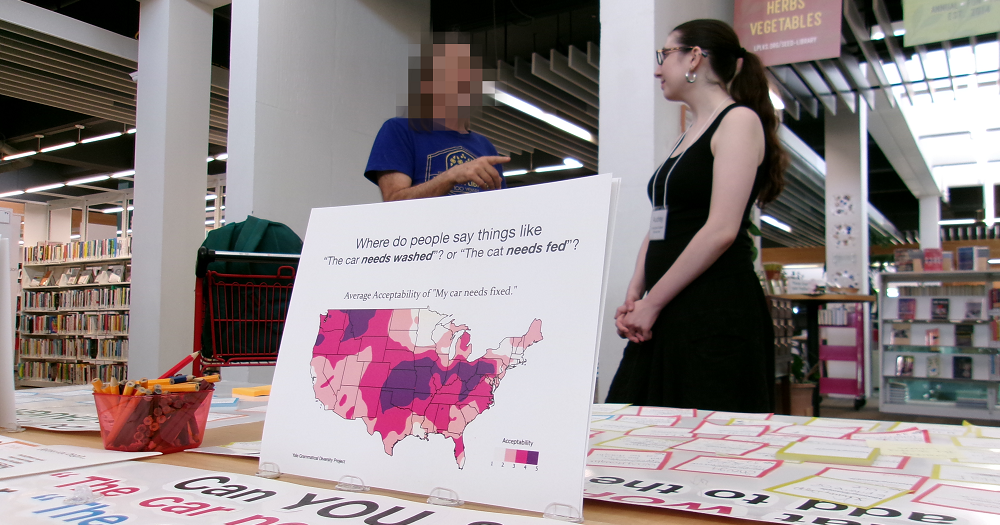
Lacey Wade is the director of the University of Kansas sociolinguistics lab in Lawrence, Kansas, USA. She and her team of faculty and students kindly answered our questions for this LingComm IRL interview, a series edited by Gretchen McCulloch and Leah Velleman highlighting face-to-face, community-driven linguistics communication activities without much of a web presence to help lingcommers learn from each others’ experiences in doing local activities.
Who are you? And what community group did you work with?
We are a group of linguists at the University of Kansas, and we collaborated with the Lawrence Public Library. See the end of the post for a complete list of names and departments!
How did you get started on this project?
Lacey originally reached out to local high schools about having graduate students visit their classrooms to teach students about linguistics, but had little success. After visiting the local public library several times for other events, she had the idea to see whether they might be interested in hosting a linguistics event. She got a very enthusiastic response, and met with the information services librarian in person the next week.
At that initial meeting, we talked through our ideas and, importantly, asked how an event we designed could help meet some of the library’s ongoing needs. From there, we began designing the event collaboratively. A few months later, Lacey and graduate students Bayleigh Baldwin and Lillianna Lamagna met with our library contact again to scope out an appropriate space for the event and start planning the details.
What sort of lingcomm project did you do?
We hosted an event called Language Exploration at the Library, a one-day pop-up event with a variety of exhibits to introduce people of all ages to linguistics and language use around Lawrence, Kansas, USA. The exhibits were all hands-on and educational, with many providing the opportunity for event-goers to participate in ongoing research studies.
What are a few specific things you did that people resonated with?
We created a variety of exhibits, each introducing a different aspect of linguistics.
- In the weeks leading up to the event, we put up posters around the library asking people things like “Do you say PIN and PEN the same?” or “What word would YOU add to the dictionary?” with custom post-its for their responses. These were a hit! We got hundreds of responses before the event even started, and we kept getting requests from the library to bring more post-its.
- We created kid-friendly activities, including an eye-tracking station, an IPA symbol bracelet making station, and a grammaticality judgement task with puppets. Something that surprised us was the amount of adults that did the activities too. The puppet show was geared towards 4–5 year olds, so we were not expecting people of all ages to have so much fun with it!
- We had a station with a short pragmatics experiment. It looked at whether people interpret the word “some” differently in face-threatening contexts, like “some people hated your casserole,” than in non-face-threatening contexts, like “some people loved your casserole.” One participant told us afterwards, “I think this is the most I’ve ever thought about what things mean!”
- We created an exhibit about regional dialects. This sparked a lot of discussion about what sounds Kansan, and what people think sounds Kansan, and how these two things are different! People also really enjoyed participating in the perceptual-dialectology-style “draw a map” task because they got to share their own thoughts about language and then hear what linguists had to say about them!
- We featured representatives for languages used in Lawrence, including Chuj, Me’pha̱a̱, Uyghur, Fula, Yoruba, African American English, and American Sign Language. We created posters that shared fun facts, basic phrases, and the personal significance these languages had to our representatives.
- We created a station about phonetics, lovingly called Articulation Station. Here we explained how the vocal tract works to produce sound, and challenged our visitors to decode words written in IPA. People seemed to be blown away by the realization that spelling and sounds really aren’t the same thing!
- One of our undergraduate students came up with a Bouba–Kiki experiment and created a short handout explaining this effect. Many of our event-goers reported in a post-survey that this was one of their favorite activities! While all of our tasks were designed to be inclusive for all ages, many of our younger visitors really liked this task in particular.
Materials will be posted on the lab website in the coming weeks: https://sociolinguistics.ku.edu/ and updated as we introduce new activities.
What’s something you’d do differently next time?
We didn’t advertise to the community much for this first event because we were treating it like a trial run, but we’d like to advertise more to the broader community for our next event. Most people who ended up stopping by were coming to the library anyway and didn’t even know we’d be there!
Where can people find out more about you or get in touch?
You can visit our lab website: https://sociolinguistics.ku.edu/ or email kusociolab@gmail.com to get in touch.
You mentioned a big group — who was involved?
We were led by Lacey Wade and the KU Sociolinguistics Lab, and include faculty, graduate students, and undergraduate students at KU. Contributors include Esther Acheampong, Abena Agyeiwaa Amoh-Yankyera, Adam An, Bayleigh Baldwin, Abba Benafeld, Morgan Brown, Evelyn Burgess, Ashlyn Dobson, Philip Duncan, Dagan Fultz, Tyler Hausthor, Jeff Holliday, Lillianna Lamagna, Margarethe McDonald, Utako Minai, Allison Monteleone, Audrey Morgan, Jamie Nelson, Stephen Politzer-Ahles, Karina Saechao, and Kameron Welch. Our group included members of the Sociolinguistics Lab, Phonetics and Psycholinguistics Lab, Developmental Psycholinguistics Lab, and Field Linguistics Lab in the Linguistics department, and the Speech in Little Bilinguals Lab in the Speech-Language-Hearing department.

